





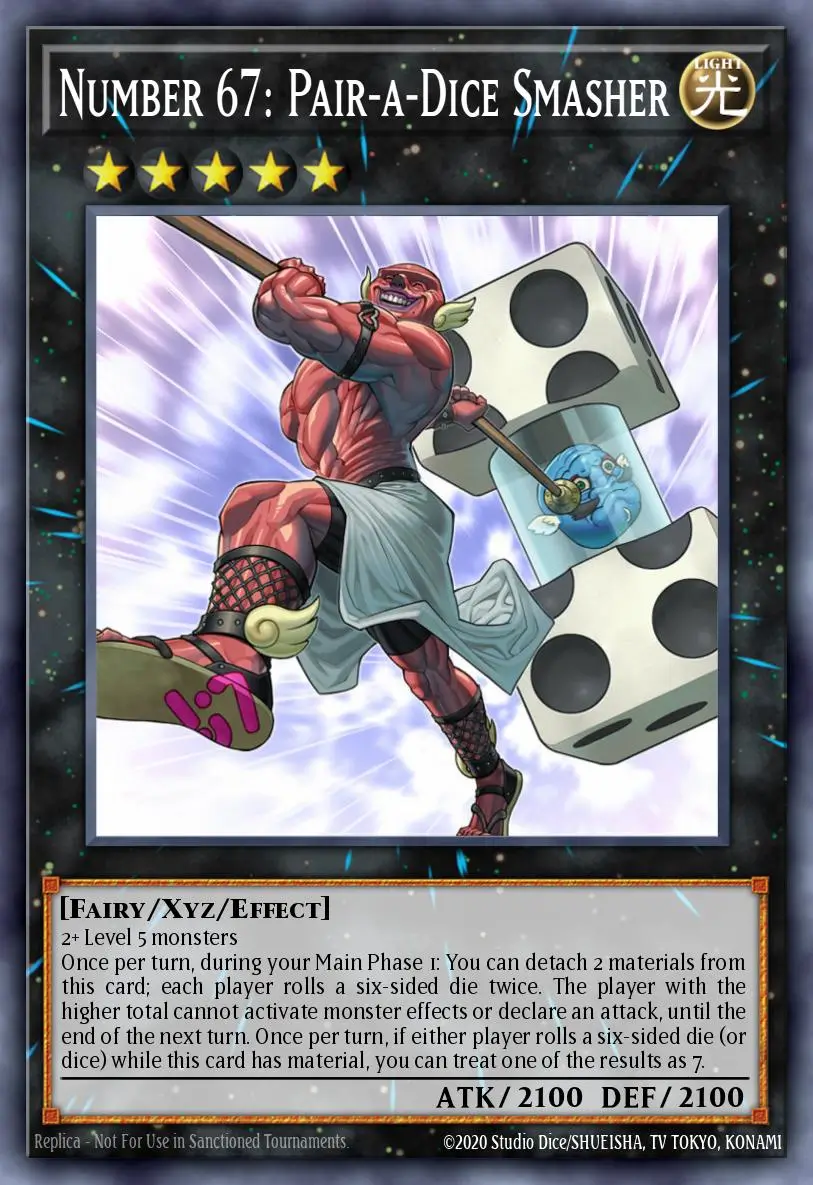

 LIGHT

Number 67: Pair-a-Dice Smasher
ATK:
2100
DEF:
2100
View:
5564
2+ Level 5 monsters Once per turn, during your Main Phase 1: You can detach 2 materials from this card; each player rolls a six-sided die twice. The player with the higher total cannot activate monster effects or declare an attack, until the end of the next turn. Once per turn, if either player rolls a six-sided die (or dice) while this card has material, you can treat one of the results as 7.


Number 67: Pair-a-Dice Smasher — Power Evaluation
Final Score: 60 ± 5 · Confidence: Medium
- Intrinsic: 65 · Deck: 59 · Meta: provisional
- Primary role: Floodgate/Control · Secondary: Negation/Interaction
Why it scores here
Number 67: Pair-a-Dice Smasher is a splashable control tech that excels in deckbuilding efficiency, running as a clean 1-of across 35+ archetypes with zero brick risk and a reusable once-per-turn disruption effect that locks either player's effects and attacks based on dice rolls. Its power is constrained by high material costs (2 per activation), zero recorded combo integration, downside randomness risk (you can lock yourself), and lack of direct advantage generation. The broad deck inclusion reflects generic utility, not intrinsic power—a guardrail-3 distinction between frequency and strength.
Axis scores
| Axis | Score | Evidence |
|---|---|---|
| Accessibility | 70 | Runs in 400/400 sampled decks across 35 archetypes as a consistent 1-copy flex slot, with Rank 5 material access confirmed in K9 (31.5%), Vanquish Soul (23.2%), and Crystron homes. (observed) |
| Combo & Conversion | 25 | Zero recorded combos and zero appearances in combo boards despite 400-deck sample, indicating the card fills a post-combo control role rather than functioning as a combo accelerant or extender. (observed) |
| Resource Economy | 40 | Costs 2 materials per activation with no card advantage return; pure disruption value with no refuel or net advantage generation. (verified) |
| Effect & Interaction | 65 | Creates hard disruption locking opponent's monster effects and attacks when you win the die roll; secondary effect treats one result as 7 to edge odds, though randomness creates self-lock risk if you roll lower. (verified) |
| Material Utility | 60 | 2100 ATK/DEF Fairy Rank 5 with no effect lock—a reasonable generic body, but not exceptional as synergy fodder or material when blanked. (inferred) |
| Resilience & Flexibility | 55 | Multi-turn reusable once-per-turn effect provides flexibility across turns while materials persist, but lacks removal protection and self-locking variance reduces overall resilience. (inferred) |
| Deck-Building Efficiency | 72 | Clean 1-of tech slot with no brick or lock-in risk; proven splashable across 35+ archetypes with high genericity and minimal deck cost. (observed) |
Calculation
Weight profile: Primary role: Floodgate/Control (single role). Intrinsic ≈ 65, Deck ≈ 59, Meta = provisional. Modifiers: Randomness reliability risk (-3); High splashability efficiency (2). Final formula: 0.40*Intrinsic + 0.60*Deck
Strengths
- High splashability across 35+ archetypes with zero brick risk; efficient 1-of slot
- Reusable once-per-turn disruption enables multi-turn presence when materials allow
- Die manipulation edge (treat one result as 7) increases odds of locking opponent vs. self
- Hard disruption effect negates both monster effects and attacks simultaneously
- No synergy lock-in; works generically in any deck with Rank 5 access
Weaknesses
- Randomness creates self-lock downside risk if opponent rolls higher than you
- High material cost (2 per activation) with finite resource pool limits activations
- Zero recorded combo integration; purely a post-combo control tool, not a combo piece
- No direct card advantage or resource generation; pure tempo disruption
- Vulnerable to removal or negation with no protective effect text
- Once-per-turn activation limit caps disruption upside per turn
Counters / choke points
- Removal/destruction effects that target XYZ monsters (Raigeki, Dark Hole, etc.)
- Hand traps that negate activation before effect resolves (Ash Blossom, Nibiru, etc.)
- Decks relying on passive boards or effects immune to negation
- Cards that interfere with die rolls or create unblockable board effects
Best use
Control tech / go-second disruption / board finisher. Decks: K9, Vanquish Soul, Crystron, Scrap. Suggested copies: 1.
Evidence & gaps
- Verified: Rank 5 XYZ Summon requirement (2+ Level 5 monsters as material); 2100 ATK / 2100 DEF, Fairy type, LIGHT attribute; First effect: Once per turn during Main Phase 1, detach 2 materials; each player rolls a die twice; player with higher total cannot activate monster effects or attack until end of next turn; Second effect: Once per turn, if either player rolls a die while this card has material, treat one result as 7; Runs in 400/400 sampled decks (100% inclusion rate in provided sample); Average 1.01 copies per deck; distribution is 395 decks with 1x, 5 decks with 2x
- Observed: Present across 35 distinct archetypes, concentrated in K9 (31.5% combined) and Vanquish Soul (23.2% combined) homes; Mixed format distribution: 62.2% gameplay type 6, 37.8% gameplay type 7; Zero appearances in 400 combo boards provided (0% combo participation); Generic staple partners (Ash, Called by Grave, ZEUS) mixed with archetype-specific synergies (K9 cards, Mulcharmy Fuwalos)
- Inferred: Card functions as post-combo control tech rather than combo accelerant (no combo data despite large sample); Die manipulation effect creates mathematical edge: treating one die result as 7 increases expected win-roll probability vs. unmanipulated rolls; Randomness mechanic creates downside: you can lock yourself if opponent rolls higher, reducing consistency; Material utility is moderate: 2100 body is reasonable for XYZ fodder but lacks exceptional synergy with other mechanics when blanked; Splashability across 35+ archetypes indicates generic utility and deckbuilding ease, not intrinsic power (guardrail 3)
- Data gaps: No combos supplied—combo conversion and board-building power are text-only inferences with no real-world confirmation No guides supplied—no human strategy context on how players actually deploy this card No StatisticsCard data—archetype inclusion percentages and typical copies inferred from 400-deck sample only, not historical averages No top-card ranking—cannot confirm whether this is a high-meta staple or a niche inclusion No rulings clarifications—edge cases with die-roll mechanic and once-per-turn stacking remain unknown